Fear That Lived in Their Fur
Inside a quiet home, two small dogs were living in constant tension.
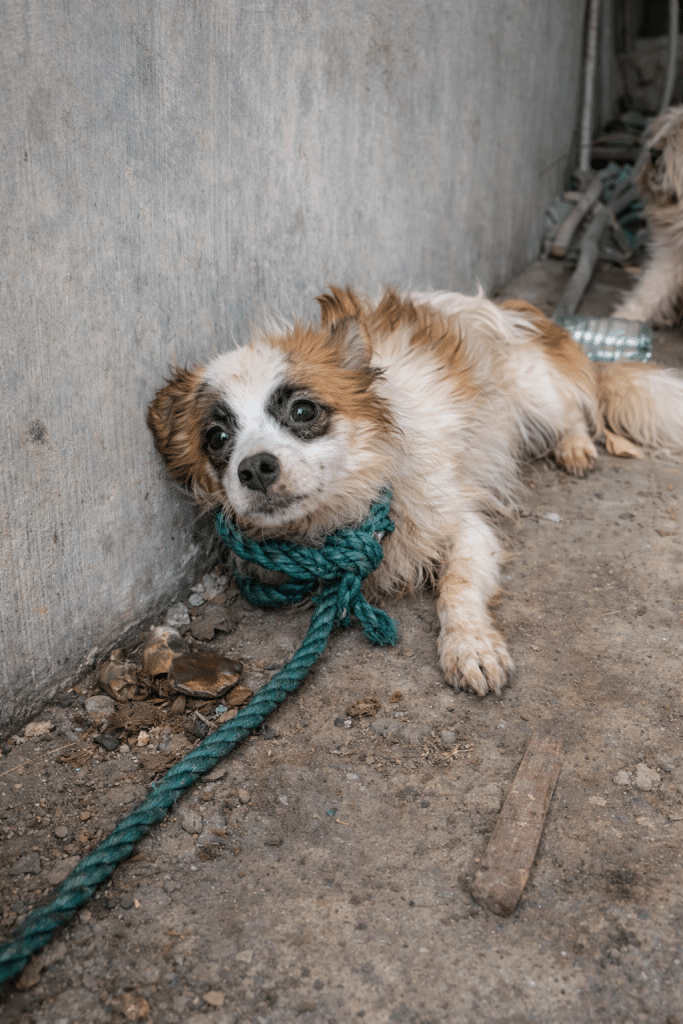
One was a white Pomeranian. The other, a tiny brown-and-white mixed breed with delicate features and wide, watchful eyes.
Their mistake had been simple — accidents inside the house.
The response had not been.
Instead of guidance, there had been harsh punishment. Instead of patience, there had been raised hands and loud voices. Over time, fear became their default state.
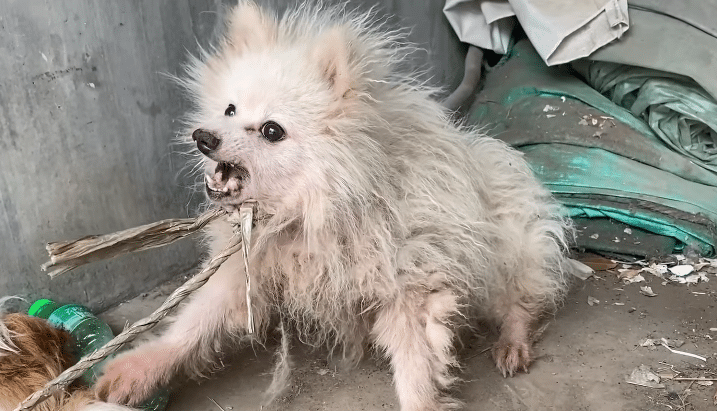
The white Pomeranian’s fur would stand on end at the slightest approach. His body stiffened like a hedgehog’s defense. He growled not out of aggression, but out of desperation — a small creature trying to protect himself in the only way he knew how.
Trust had disappeared.
A Decision That Changed Their Path
When rescuer Dai Thu arrived, he listened carefully. The owner insisted things would improve. Promises were made.
But fear does not vanish with words.
Looking at the trembling dogs, he understood something deeper: safety is not just physical. It is emotional.
He made the decision to bring them to the rescue center, where their recovery could begin in an environment built on calm and consistency.
They left quietly.
Still wary.
Still uncertain.
When Defense Is Just Survival
The early days were not easy.
The smaller mixed-breed dog reacted sharply to touch. If someone reached too quickly, he snapped. If approached unexpectedly, he retreated or barked.
This was not cruelty.
Video: The First Tail Wag After Fear Begins to Fade
It was trauma.
Long exposure to fear can teach an animal that every hand might hurt. Relearning safety takes time.
Instead of forcing contact, Dai Thu adjusted his approach.
He sat nearby during meals. He placed food gently within reach. He spoke softly. He allowed space.
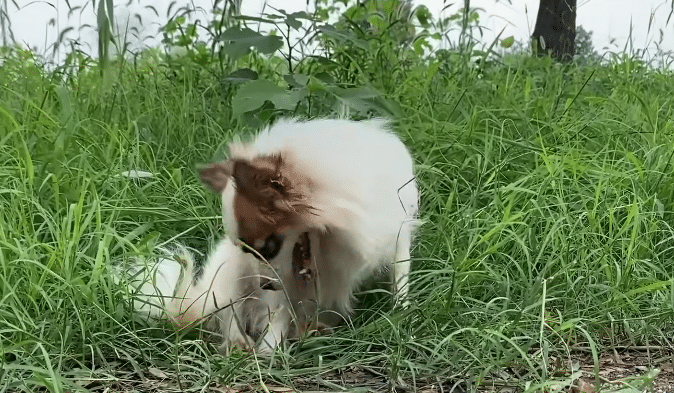
He brought them to a park, where sunlight filtered through trees and grass replaced hard flooring. There, something subtle began to shift.
The smaller dog paused before reacting.
Then one day, his tail moved — just slightly.
It was the first sign of softening.
In the footage, you can see it clearly — the moment when tension gives way to curiosity. The once-defensive posture loosens. The tail lifts. A hesitant wag appears.
It is not dramatic.
But it is profound.
Healing More Than the Body
Alongside emotional recovery, physical care was essential.
The Pomeranian’s coat had thinned in patches due to skin conditions and poor hygiene. Regular medicated baths were introduced gently, along with parasite treatments and careful grooming.
Another white dog in their care, named Nhi Dau, carried a large scar on his head — now healed but once untreated.
Each dog received deworming, supportive nutrition, and gentle massage to help relax muscles that had stayed tense for far too long.
Healing was not just about removing illness.
It was about removing fear from the body.
From Guarded to Gentle
Weeks passed.
The once-snapping little dog began approaching on his own. He followed his rescuer around the room. He leaned into touch instead of recoiling from it.
The Pomeranian’s fur grew softer. His posture changed. The defensive growl disappeared, replaced by playful energy.
Their eyes, once filled with suspicion, now held something different.
Relief.
When Trust Is Rebuilt, One Moment at a Time
Trust, once broken, does not return overnight.
Sometimes it never returns in exactly the same way.
But it can be rebuilt — gently, patiently, through consistent kindness.
These dogs are now ready for adoption. Not because they have forgotten the past, but because they have learned that the future can be different.
They will need homes that understand that healing continues even after rescue.
Homes where patience is steady and love is quiet but reliable.
Their story reminds us that fear often hides behind behavior we misunderstand.
And that with time, even the smallest, most frightened heart can learn to feel safe again.
Sometimes, all it takes is someone willing to sit down — and wait — until the wag returns.