The video begins beside a rocky riverbed.
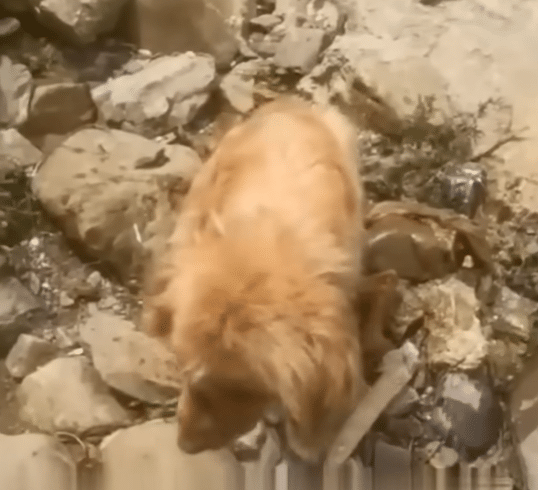
There, in the shallow current of icy water, a Golden Retriever stands half-submerged. The stream moves gently around him, but he does not move much at all.
His eyes tell the story first.
Exhaustion.
Confusion.
A quiet kind of surrender.
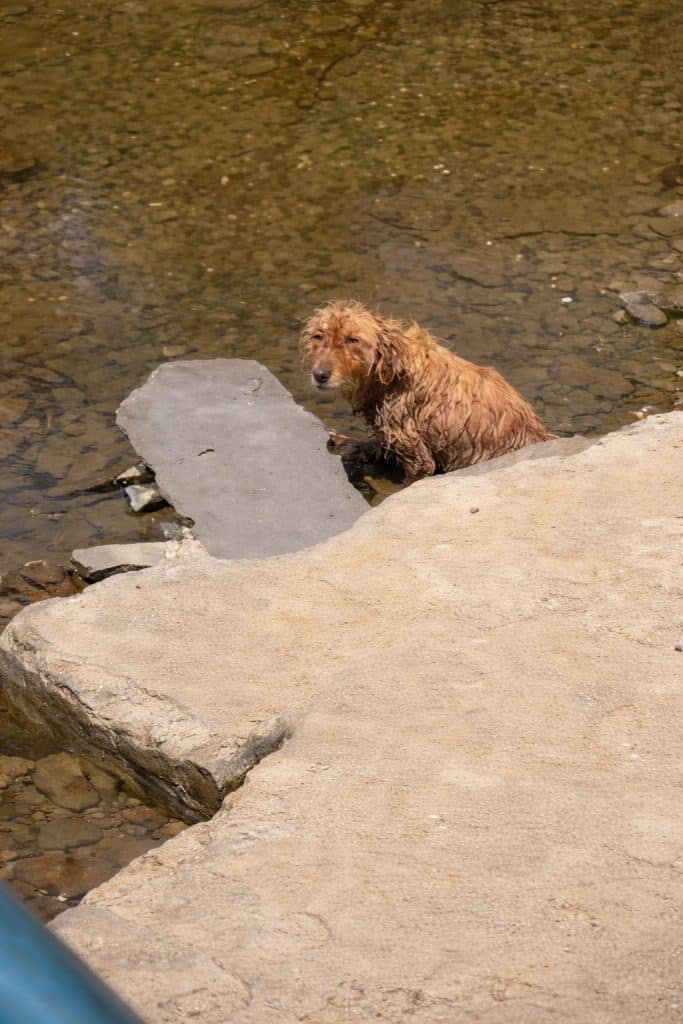
When the rescuer lifts him from the water, the truth becomes painfully clear — his two hind legs hang lifeless behind him.
He cannot stand.
He has been dragging himself across sharp stones.
No one knows exactly how long he had been there, but it is difficult to imagine he arrived by accident. A disabled dog abandoned near a river often means only one thing: someone decided he was no longer worth keeping.
The rescuer feeds him sausages and dry kibble. The dog eats eagerly, as if he hasn’t tasted kindness in a long time.
That day, he leaves the river in a cardboard box.
He leaves with hope.
A New Name and a Hard Truth
The next day, the rescuer brings the dog to his parents’ home in the countryside. His mother and father are immediately moved by the sight of him. They cook chicken breast to nourish the fragile body that has already endured too much.
At the veterinary clinic, the diagnosis comes.
Both hind legs were fractured long ago.
Video: From a Frozen Stream to Taking His First Steps Again — Candy’s Journey
The injuries had healed improperly. There was no simple surgical solution left.
He would never walk normally again.
Yet something about him stands in contrast to that verdict.
He eats well.
He looks up when spoken to.
His spirit is intact.
The rescuer gives him a new name: Candy.
A wish disguised as a word — that his life from now on will be sweet.
A Wheelchair and a Promise
Candy cannot continue dragging himself across the ground.
So the rescuer builds something with his own hands — a custom wheelchair designed to support Candy’s hind legs.
The first time Candy is placed into it, there is hesitation.
Then curiosity.
Then movement.
For the first time since his rescue, he moves forward without scraping his body against stone or dirt.
He can explore.
He can graze on grass.
He can feel wind without pain.
Daily life requires effort.
Candy cannot relieve himself independently. The rescuer patiently cleans up every day, never complaining. Meals are carefully prepared — chicken, broccoli, carrots — balanced and nourishing.
Slowly, Candy gains weight.
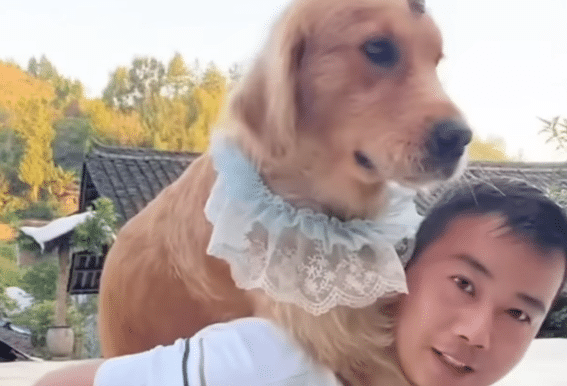
But more importantly, he gains confidence.
He begins to smile.
He rolls onto his back for belly rubs.
He leans against his rescuer as if anchoring himself to safety.
The Miracle No One Promised
Despite the veterinarian’s prognosis, the rescuer does not give up entirely.
Each day, he removes the wheelchair and massages Candy’s hind legs. Gentle stretching. Careful pressure. Encouragement.
At first, there is nothing.
Then — one day — a reflex.
A small twitch.
The rescuer continues.
Weeks pass.
Candy begins to support his weight briefly while eating. His legs tremble, but they hold.
A month later, a more advanced clinic confirms what no one expected: continued therapy might allow further improvement.
And so they persist.
Step by step, wobble by wobble, Candy begins to take short, uneven steps without the wheelchair.
Not perfect.
But real.
A Life Rewritten
Today, Candy waits faithfully by the door each afternoon, anticipating his rescuer’s return from work.
He sleeps on a warm cushion.
He plays with toys.
He no longer drags himself across freezing rocks.
From a dog abandoned in a cold stream — discarded because he could not run — he has become a companion who walks, however imperfectly, beside someone who chose him.
The video closes with a quiet message:
Love is a kind of medicine.
It does not always rewrite biology overnight.
But sometimes, with patience, it awakens what seemed permanently lost.
And perhaps one day, under the sunlight, Candy will run — not because someone demanded it of him, but because someone believed he could.