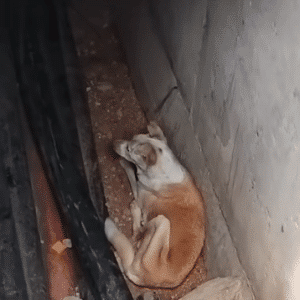
Some rescues arrive with a warning. Others arrive quietly, without announcement, unfolding into moments that change lives forever. Blackie and Reiki’s story began on a cold November evening, one that started like any other and ended with two forgotten souls finally being seen.
It was around 9:00 PM on November 1st when a woman, having just purchased a new home, made a discovery she never expected. The property had been abandoned for nearly a month. No lights. No voices. No signs of life. And yet, hidden in the darkness of the yard, two dogs were still there—waiting.
They had been left behind.
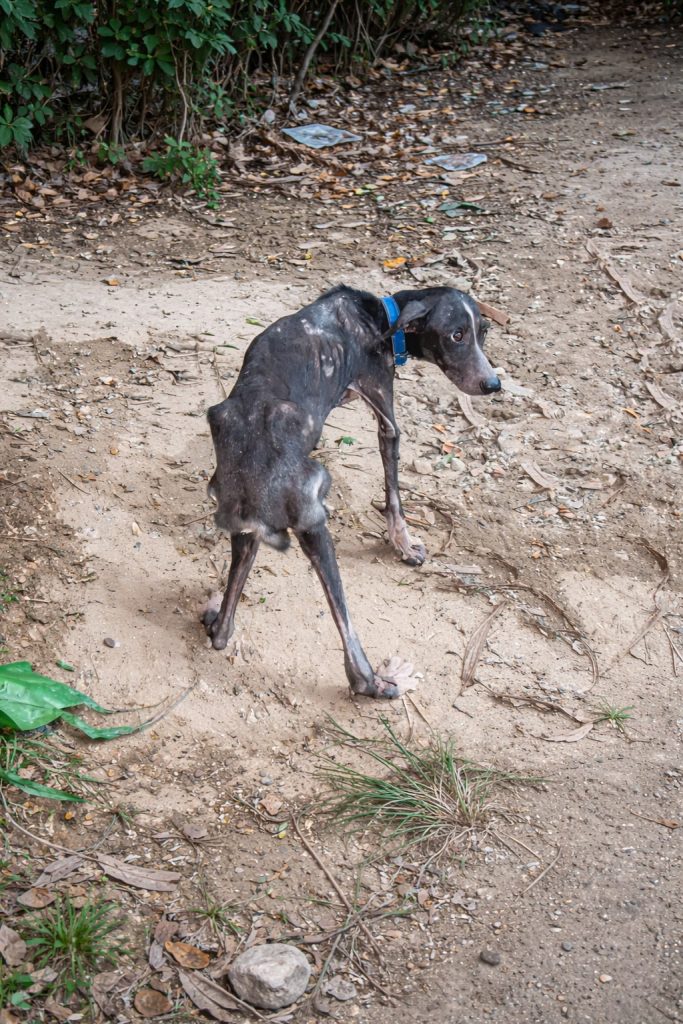
When help arrived, the contrast between the two dogs was immediately clear. Reiki, the sister, was the first to react. She froze when she saw a human, her body tense, eyes wide with disbelief. It was as if she couldn’t quite process that someone had finally come back. She didn’t bark or run. She simply stood there, alert, cautious, and unsure whether hope was real or just another disappointment.
Blackie, her brother, was in far worse condition.
Tied to a tree with limited movement, Blackie’s body told a devastating story. He was dangerously thin, so emaciated that every bone was visible beneath his skin. His strength was nearly gone, yet his voice wasn’t. When he cried out, it wasn’t aggression or fear—it was a plea. A sound that carried exhaustion, hunger, and the simple desire to be noticed.
The realization was crushing. Both dogs had likely been trapped on the property for the entire month it sat vacant. No consistent food. No care. No comfort. Just silence and survival.
There was no time to hesitate.
They were rushed to the veterinarian immediately, knowing that Blackie, in particular, might not survive without urgent intervention. His condition was critical. Severe malnutrition had weakened his body, and parasites had taken advantage of his fragile state. His gums were pale, his energy dangerously low. The veterinary team moved quickly, administering a life-saving blood transfusion and beginning intensive treatment to stabilize him.
VIDEO From Despair to Hope: How Blackie and Reiki Found Their Way Back to Life
Reiki’s condition, while less severe, still reflected prolonged neglect. She was underweight, dehydrated, and emotionally shaken. Physically stronger than her brother, she nonetheless showed signs of confusion and stress—an understandable response after weeks of isolation.
After their initial treatments, Blackie and Reiki were brought into a home environment where recovery could truly begin.
The difference in their healing journeys became clear almost immediately.
Blackie couldn’t stop eating. His hunger was relentless, not from greed, but from weeks of deprivation. Each meal was approached with urgency, as if he feared it might be his last. His body, fragile and exhausted, needed time to adjust. Care had to be careful and consistent. Too much, too fast, could be dangerous—but so could too little. Every day required attention, patience, and monitoring.
Reiki adjusted more quickly. She ate steadily, rested calmly, and began observing her new surroundings with curiosity rather than fear. While she stayed close to Blackie, she seemed to sense that something had changed. That this place was different.
The first week was the hardest for Blackie.
His movements were slow. Standing took effort. Resting came with deep, heavy breaths. Yet even in his weakest moments, his spirit refused to disappear. He followed voices with his eyes. He leaned into gentle touch. He responded to kindness in ways that felt almost immediate, as though he had been waiting his entire life for it.
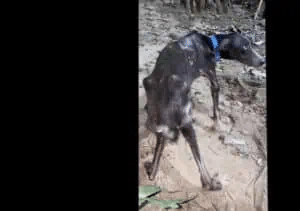
Day by day, strength returned.
Reiki, meanwhile, began to blossom. Her personality emerged quickly—playful, affectionate, and eager for connection. She learned to trust faster, wagging her tail freely and seeking out attention. Watching her transformation was joyful, but it also highlighted just how much Blackie had endured.
And then, something incredible happened.
Weeks passed, and the changes became undeniable.
Blackie’s frame began to fill out. The sharp edges of his bones softened. Muscle returned. His coat, once dull and sparse, grew thick and shiny. His energy increased steadily, and soon, the dog who once struggled to stand was walking confidently, even trotting with excitement when meal time or play time arrived.
Most striking of all were his eyes.
Where there had once been exhaustion and resignation, there was now light. Curiosity. Joy.
Reiki thrived right alongside him. She became an affectionate companion, always nearby, always ready to play or curl up for rest. Her confidence grew as she explored the world beyond the yard she had been trapped in. She learned what it meant to feel safe, to sleep deeply, and to greet each day without fear.
One month after their rescue, Blackie and Reiki were nearly unrecognizable.

They were no longer the forgotten shadows found on an abandoned property. They were healthy, vibrant dogs—full of life, personality, and trust. Their bond remained strong, shaped by survival and strengthened by healing. Together, they moved forward, no longer defined by what they had lost, but by what they had gained.
Witnessing their transformation was deeply moving.
Blackie and Reiki are living proof that even after prolonged neglect, recovery is possible. That bodies can heal. That spirits can rebound. And that love—consistent, patient love—can undo damage that once seemed irreversible.
Their story is not just about rescue. It’s about responsibility. About noticing when something is wrong. About stepping in when others walk away. And about the profound impact compassion can have when it’s offered without conditions.
Today, Blackie and Reiki have the future they were once denied. They wake up fed. They rest without fear. They play, explore, and trust again. And in doing so, they remind us of something essential: no life is too far gone to be worth saving.
Sometimes, hope arrives late at night, on an abandoned property, in the form of two dogs who refuse to give up. And sometimes, all it takes to change everything is one person willing to stop—and care.