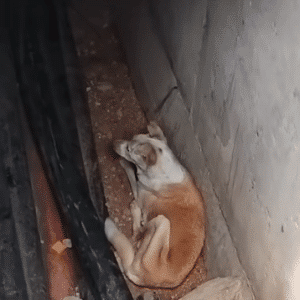
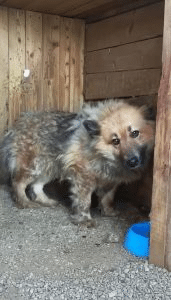
When Elena entered her local animal shelter, she expected the familiar sounds—barking, movement, dogs eager for attention. Instead, what caught her attention was the absence of noise. In a quiet corner, partially concealed behind a half-open door, a dog stood perfectly still. She did not bark. She did not approach. She simply watched, her wide eyes reflecting caution rather than curiosity.
Her name was Asya.
Fear That Was Never Aggression
Asya’s stillness was not defiance. It was calculation. Every movement she made appeared measured, as though she was carefully deciding whether it was safe to exist in the moment. Sudden sounds caused her to flinch. Unexpected gestures made her retreat. Many visitors passed her by, unsure how to approach a dog who seemed overwhelmed by even the smallest interaction.
To some, Asya appeared difficult.
To Elena, she appeared frightened—and misunderstood.
Looking Beneath the Behavior
Elena spoke with shelter staff and learned that Asya’s history was incomplete. There were unanswered questions and behaviors that didn’t quite fit the label of “shy.” Elena felt that before anyone could truly help Asya, they needed to understand what was happening beneath the surface. She gently insisted on a full veterinary evaluation, trusting her intuition that fear alone was not the whole story.
That decision became the turning point.
VIDEO: From Fear to Flourishing — How Gentle Care Helped Asya Find Her Way Home
A Diagnosis That Brought Clarity
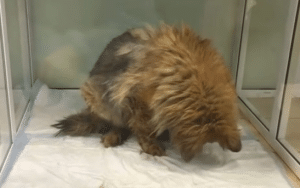
At the veterinary clinic, Asya was approached with patience and calm. Her movements immediately stood out. She walked in slow, uncertain patterns, sometimes circling as if trying to orient herself. Her reactions were delayed, her awareness inconsistent. Despite this, she remained remarkably cooperative, enduring exams without resistance.
Further testing revealed the cause: Asya had suffered a significant head injury earlier in her life. The trauma had altered her skull and affected her neurological function. Her fear was not behavioral—it was neurological. She wasn’t choosing to be anxious. She was navigating a world that often felt confusing and unpredictable.
The diagnosis was serious, but it was not hopeless. Veterinarians focused on stabilization rather than limitation. A treatment plan was created that included medication, supplements, and targeted nutrition to support her neurological health. Just as important was the recommendation for a calm, structured environment—one where Asya could rely on routine and gentle handling to rebuild her sense of safety.
Healing Measured in Quiet Progress
Recovery did not happen overnight. In the early weeks, progress appeared in subtle ways: steadier steps, longer moments of eye contact, calmer responses to familiar voices. Gradually, Asya began leaning into gentle affection. The dog who once recoiled from touch discovered that hands could bring comfort instead of fear.
Her posture softened.
Her pacing slowed.
Her eyes began to rest instead of scan.
With time, curiosity replaced anxiety. Short, cautious walks became confident ones. Play emerged where tension once lived. Shelter staff watched as Asya transformed—not into a different dog, but into the version of herself that fear had been hiding.
A Home Built on Understanding
When a family came forward, they were drawn not by perfection, but by potential. They took the time to understand Asya’s needs and committed to providing patience, consistency, and calm. In her new home, Asya continued to thrive. Sunlit naps replaced shelter floors. Predictable routines replaced uncertainty. Walks became moments of enjoyment rather than stress.
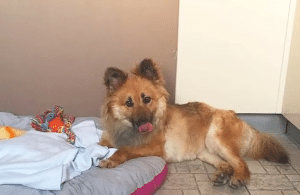
Asya’s story is not about returning to who she once was. It is about becoming who she was always meant to be—with support.
Today, Asya lives a life shaped not by trauma, but by care. Her journey is a reminder that healing often begins when we stop asking animals to “push through” fear—and instead choose to understand it. Sometimes, gentle care is all it takes to help a lost soul find her way home.