Day 1 — Frozen and Unable to Escape
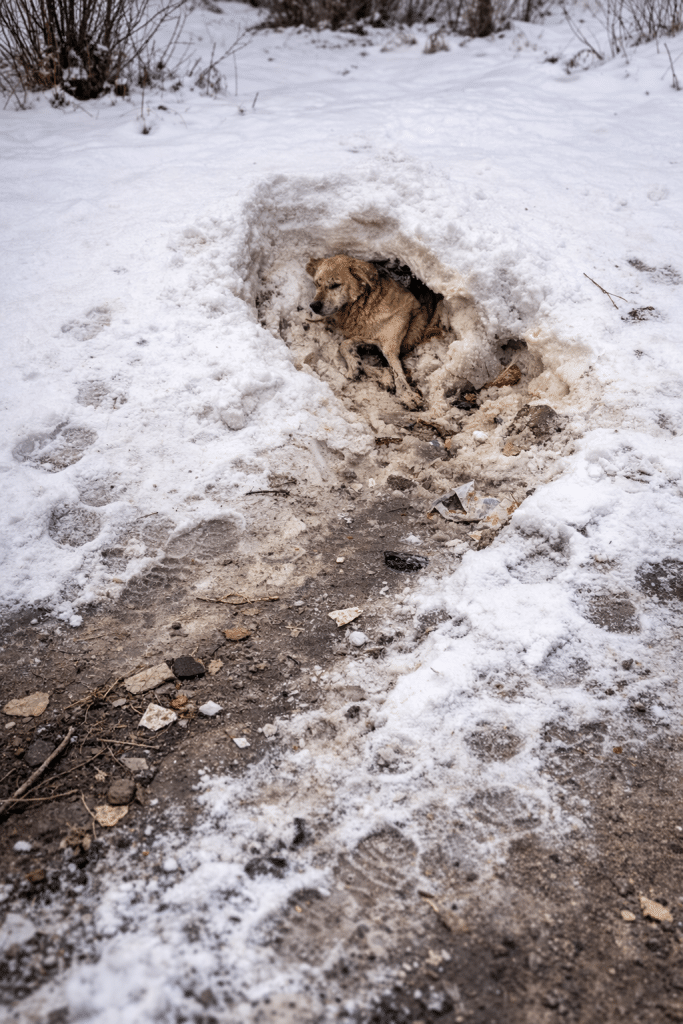
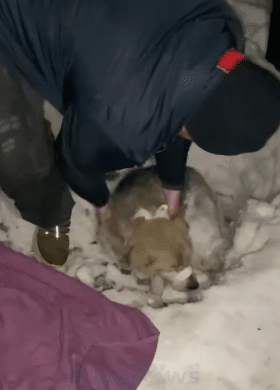
Mishka was found trapped in a snow pit, where he had been stuck for three to four days.
He was unable to run.
Unable to stand.
His body was numb from the cold.
When rescuers lifted him out, it became clear this was more than hypothermia.
X-rays revealed devastating injuries: multiple pelvic fractures and several lead bullets lodged throughout his body. One bullet rested dangerously close to his spine.
He was in extreme pain.
And he could not get up.
The medical team faced a difficult decision.
Surgery on the pelvis carried enormous risk. Instead, after careful discussion, they chose a different path — aggressive pain management and immediate but gentle physical therapy to prevent muscle atrophy.
For days, Mishka remained under close observation, receiving round-the-clock care.
By day ten, he began practicing assisted movement using a wheelchair and a support harness.
The prognosis had been uncertain.
But Mishka tried anyway.
Days 16–38 — Small Signs of Recovery
Recovery was not linear.
But small milestones appeared.
Video: From a Snow Pit to His First Steps on Grass — Mishka’s Turning Point
Mishka’s emotional state improved. He became more affectionate, more engaged with caregivers.
Then came a critical breakthrough: he was able to relieve himself independently — a sign that nerve function was slowly returning.
He was transferred to the Yuna Veterinary Center for advanced rehabilitation.
There, he trained outdoors in snow and indoors with mobility equipment, adjusting to life on wheels while his body strengthened.
Days 40–110 — Strength Through Water
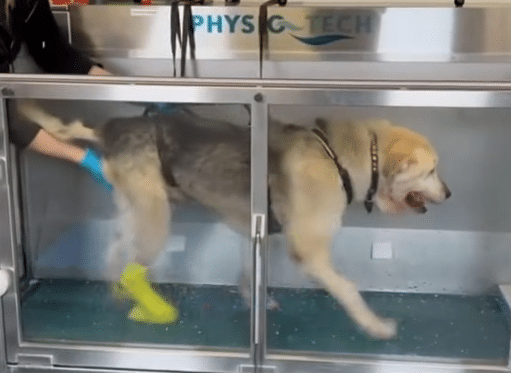
Hydrotherapy became central to his recovery.
Mishka trained on an underwater treadmill (aqua track), where buoyancy reduced pressure on his fragile pelvis while building muscle strength.
The veterinary team remained persistent.
Every session was carefully monitored.
By day seventy-two, his movements became more stable.
By day one hundred ten, something remarkable happened.
Mishka walked on grass using his own legs.
Slowly.
Carefully.
But independently.
Days 130–360 — A Different Life Entirely
As the months passed, Mishka transformed.
The dog once frozen in pain now carried energy and curiosity.
He lived in foster care, surrounded by structure and steady affection.
His coat thickened.
His muscles strengthened.
By day 360, nearly one year after being found in the snow, Mishka ran again — across snowfields, alongside other dogs, under open skies.
The bullet in his spine remained.
But it no longer defined him.
What Mishka’s Story Proves
Mishka’s recovery was not a single miracle moment.
It was daily therapy.
Controlled movement.
Pain management.
Consistency.
It was a team that chose persistence over doubt.
From being immobilized in snow with shattered bones to walking on grass a year later, Mishka’s journey reflects the powerful intersection of medical care and unwavering dedication.
If this story moved you, watch the full video above and witness how one year of steady rehabilitation can turn near-paralysis into movement — and despair into freedom.