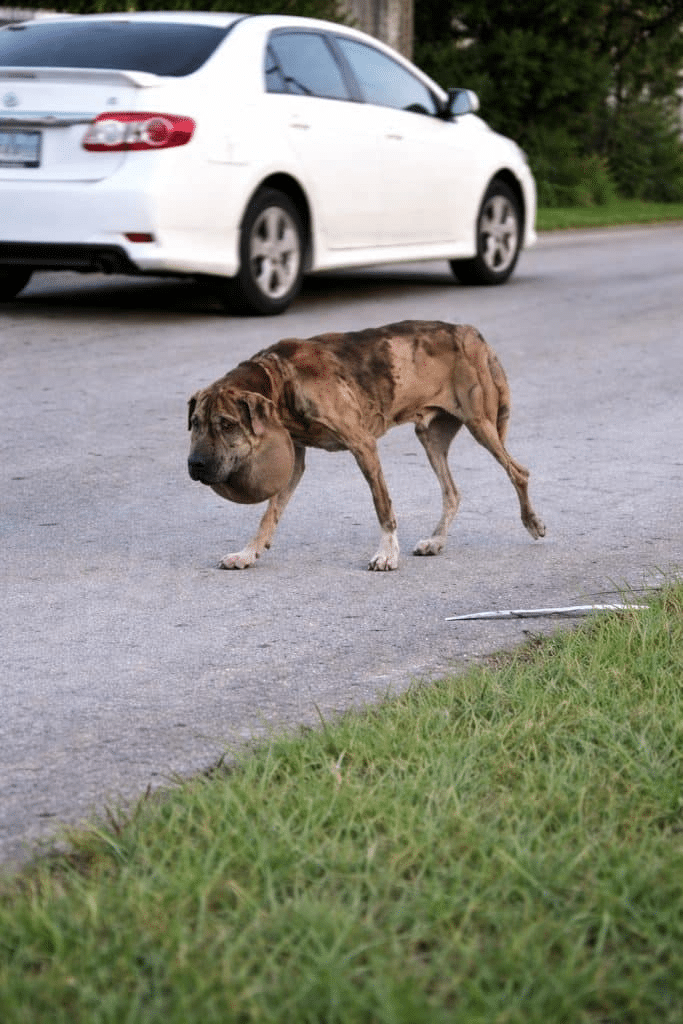
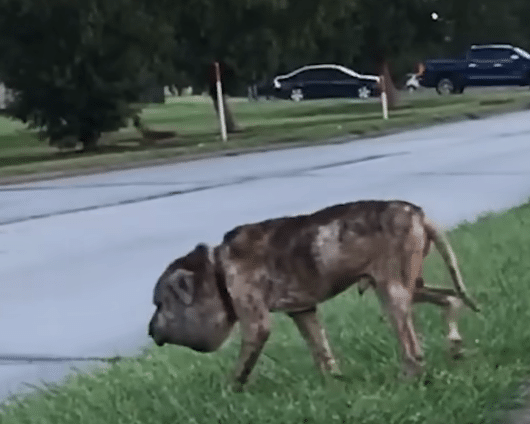
Late one summer day near Houston, Texas, drivers on a busy street noticed something unusual moving between the cars.
At first, it looked like a stray dog simply crossing the road. But when people looked closer, they realized something was terribly wrong.
The young dog’s head was severely swollen—far larger than it should have been.
Despite the obvious discomfort, he kept walking. His tail hung low, his steps cautious, yet he continued forward through traffic as if guided by instinct alone.
It was a heartbreaking sight.
Among those who noticed him was Laura Forma, an independent dog rescuer who happened to be driving through the area that day.
The moment she saw him, she knew something wasn’t right.
The dog wasn’t barking or crying out. He wasn’t lying down in defeat. Instead, he was moving slowly along the road, weaving between vehicles with quiet determination.
Laura pulled over immediately and tried to approach him.
But the frightened dog had learned to keep his distance from people. When she moved closer, he ran in the opposite direction. Food didn’t tempt him, and gentle words couldn’t convince him to stop.
Fear had become his survival instinct.
When the dog disappeared into a gated housing complex, Laura tried everything she could to find him. She spoke with security guards, searched nearby areas, and waited in hopes he might return.
But eventually, the trail went cold.
Reluctantly, she left the area—frustrated, worried, and heartbroken. Still, she refused to give up completely.
As soon as she could, Laura shared the dog’s story online, hoping someone might recognize him or help locate him.
Her message reached Anna Barbosa, president and cofounder of Houston K-911 Rescue.
By coincidence, Anna was already close to the neighborhood.
Without hesitation, she went out searching.
She spoke with residents, walked through nearby streets, and checked every place where the dog might have gone. But despite hours of searching, there was no sign of him.
Once again, the dog seemed to have vanished.
Later that same day, Laura returned—this time with two volunteers determined to try again.
Video: Gus’s Second Chance — How One Young Dog Overcame the Unthinkable and Learned to Trust Again
Their persistence finally paid off.
They found the young dog hiding inside a storage unit near an apartment complex. Exhausted and frightened, he had retreated into the small space, hoping to remain unseen.
This time, with patience and care, the rescuers were able to safely capture him using a humane trap.
That moment marked the beginning of a completely different chapter.
The dog was rushed to a veterinary clinic where doctors finally discovered the reason behind the shocking swelling in his head.
A shoelace had been tied tightly around his neck.
As the young dog grew, the lace had not loosened. Instead, it slowly tightened, restricting circulation and preventing fluids from moving normally through his body.
Over time, pressure had built up in his head and neck, causing the severe swelling people had noticed on the street.
But that was not the only discovery.
Veterinary imaging revealed that the dog—now named Gus—also had multiple pellets lodged in his body, suggesting that he had been shot at some point during his short life.
Exactly how it happened may never be known.
What mattered most was the reality in front of the rescue team.
Gus was only about eight months old, yet he had already endured more hardship than many animals ever experience.
The veterinary staff worked quickly, focusing first on stabilizing his condition and relieving the dangerous pressure caused by the shoelace.
In the early hours of treatment, his situation was critical.
Gus was in severe pain. He remained withdrawn and emotionally distant, focused only on enduring the moment.
But slowly, things began to change.
With careful medical treatment and constant monitoring, his body started responding to care. The swelling gradually reduced, his breathing improved, and the immediate danger began to pass.
When he was finally strong enough to leave the hospital, Gus moved to a foster home with Marina Harrison, a volunteer experienced in helping rescue dogs recover in a calm environment.
At first, Gus remained cautious.
Everything around him was unfamiliar. New sounds, new people, new surroundings—all of it required time to process.
But day by day, his confidence grew.
He began eating well. He relaxed during quiet moments. And one day, his tail wagged.
At first, it was only a small movement.
Then it happened again.
Those simple gestures meant everything to the people caring for him. They were signs that Gus was beginning to feel safe.
As weeks passed, his personality slowly emerged.
Marina noticed that Gus was curious and gentle. He enjoyed resting near other dogs and often tried to sneak into their beds, looking for comfort and companionship.
For a dog who once avoided all contact with humans, the change was remarkable.
Love, patience, and consistency were teaching him something new.
People could be trusted.
Gus’s recovery is still continuing. He will need more time before he is fully ready for adoption.
But those who have spent time with him say his transformation is incredible.
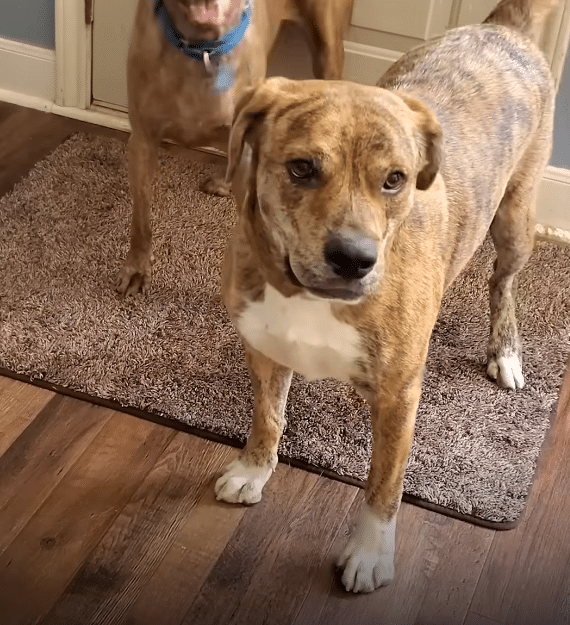
The dog who once wandered the streets with a painfully swollen head now greets visitors warmly. He leans into hugs, offers affectionate kisses, and happily seeks attention.
What makes Gus’s story truly powerful is not just his survival.
It is his resilience.
Despite everything he endured, Gus never lost his capacity to love.
He didn’t become permanently fearful or aggressive. Instead, once given care and safety, he chose connection.
He chose trust.
Today, Gus is searching for a forever home—a place where his story can continue in peace and security.
Those who know him believe he will grow into a loyal, affectionate companion, ready to return the love he has finally received.
His past will always be part of his story.
But it no longer defines his future.
Stories like Gus’s remind us why animal rescue work matters so deeply. They show how awareness, compassion, and determination can completely change the course of a life.
Gus kept walking even when he was hurting.
And because people refused to stop searching for him, he now has the chance to live the life he always deserved.