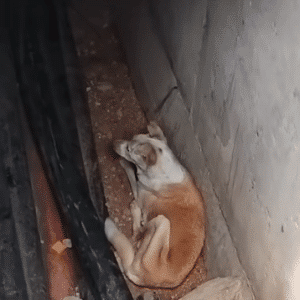
The day María was found, the air itself felt heavy. Temperatures had climbed to an unforgiving 42°C, the kind of heat that drains strength from even the healthiest body. Grass lay scorched beneath the sun, and the world seemed to move more slowly, as if everything was trying to conserve energy. That was when a photograph appeared—one that stopped people mid-scroll and stirred an immediate sense of urgency.
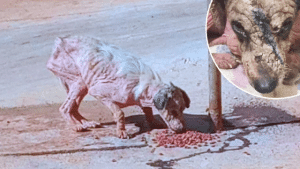
In the image, a small dog lay curled in the grass, her body drawn inward as though she were trying to shrink away from the world. That dog was María.
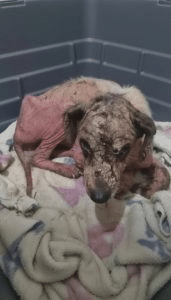
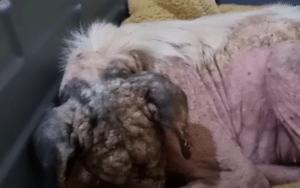
Up close, her condition told a story no animal should have to live through. Severe mange had stripped away her fur, leaving her skin raw, inflamed, and painfully sensitive. Each breath required effort. When a gentle hand finally reached her, María cried out—not in panic, but in a way that revealed how exhausted she truly was. It was the sound of a body pushed beyond its limits finally realizing it was no longer alone.
That moment marked the first shift in her journey.
María had not always been a stray. She had once belonged to a family, had once known shelter and routine. But as her health declined and her appearance changed, she became inconvenient. When her condition worsened, she was left outside, exposed to relentless heat without shade or water. Day after day, she waited. Dogs often do. They believe someone will return.
No one did.
Video When the Heat Nearly Took Everything, Compassion Gave María Her Life Back
When rescuers arrived, they moved quickly, knowing that hesitation could cost María her life. At the veterinary clinic, the full extent of her condition became clear. She was dangerously underweight, severely dehydrated, and battling a serious skin infection that had gone untreated for far too long. Her immune system was exhausted, stretched thin from trying to survive on its own.
Treatment began immediately, but everything was done gently. María’s skin could not tolerate harsh care. Baths were slow and calming, designed to soothe rather than overwhelm. Fluids were administered carefully. Nutrition was introduced in small amounts, allowing her body time to adjust.
The first days were quiet and uncertain.
María barely moved. She flinched at unfamiliar sounds. She avoided eye contact, unsure whether kindness would last. No one rushed her. Caregivers stayed nearby, offering presence instead of pressure. Food and water were offered patiently. Soft voices filled the room.
Slowly, something began to change.
María started eating more consistently. She slept deeply for the first time in a long while. Her breathing became steadier. These changes were subtle, but they mattered. Each small improvement felt like a step away from the edge.
Weeks passed, and healing became visible. Her skin began to calm. Redness faded. Thin patches of fur slowly returned. As her physical pain eased, her emotional walls began to lower. The fear in her eyes softened. She started watching the world with curiosity instead of dread.
María’s personality emerged quietly. She wasn’t demanding or energetic. She was gentle, observant, and affectionate in her own reserved way. She learned that hands could be safe. That food would arrive regularly. That rest did not have to be temporary.
As her strength returned, so did her confidence. María began walking without discomfort, then running in short bursts. She wagged her tail freely for the first time. She started interacting with other dogs, forming calm, reassuring bonds.
The sun, once her enemy, became something she could enjoy again—during peaceful walks and shaded afternoons. She no longer feared it.
At one point, rescuers confronted the person who had abandoned her. The interaction confirmed what had already been understood: María had been failed when she needed help the most. But that chapter no longer defined her.
What defined her was where she was now.
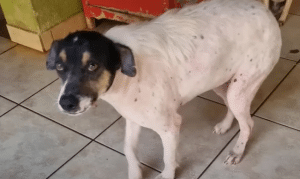
There came a moment when it became clear that María had already found home—not because of a building, but because of trust. She followed without hesitation. She rested close. She no longer braced herself for harm.
María’s story is not just about survival. It is about what happens when compassion arrives at the exact moment it is needed. It is proof that even after neglect, healing is possible. And it reminds us that kindness, when offered patiently, can rebuild a life piece by piece.